

Quick answer
Replacing gutters on an older Peninsula home: Replace instead of repairing when the joints leak all along the house, the hangers keep pulling out of the wood, or the same runs overflow every winter even when they are clean. A good replacement is more than new metal: each run is sized for the roof above it, formed as one seamless gutter at your curb, hung on screw hangers set into solid wood, and given downspouts that carry the water away from the house. Call (650) 600-0598 or get a free quote.
Postwar rooflines
Why so many Peninsula gutters are due for replacement
A lot of the Peninsula was built in a hurry after the war, and plenty of those houses are still wearing their first or second set of gutters.
Sunnyvale is a good example. The Metropolitan Transportation Commission’s Sunnyvale census history shows a town of 9,829 people in 1950 that had grown to 52,898 by 1960 and 95,408 by 1970. The 1960 count alone found 15,236 housing units. The story repeats up and down the Peninsula. Mountain View was mostly built between 1950 and 1970. In West Menlo Park the median home dates to 1963, and in Sharon Heights Census figures put the median at 1971, with 82 percent of homes built before 1980.
Older doesn’t automatically mean worn out. But the systems we take down on these homes tend to share the same weak points.
Rain here also arrives in a particular way. Our installation page puts Sunnyvale at roughly 13 to 15 inches a year, nearly all of it between November and April. Working from the USGS figure of 27,154 gallons per acre for each inch of rain, a 2,000 square foot roof sends about 1,250 gallons to its gutters every inch.
What an original system usually looks like
Three things come up again and again. First, the gutters are sectional, short lengths joined on the house, with every joint depending on old sealant. Second, they hang on nail and ferrule hangers: a long spike driven through the front of the gutter, through a tube and into the wood. The wood swells in the wet months and shrinks through the dry summer, slowly working the spikes loose. Third, the whole house carries one gutter size, even though additions, second stories and new tile roofs have since changed how much water reaches each run.
What we find
Repair or replace: how to tell on an older home
We would rather keep a sound system working than sell a new one. The question is whether the problem is one spot or the whole system.
Walk the house during a real storm and note where water comes over the edge, where joints drip and where the wood behind the gutter is stained. One or two items from the repair column below is normal for an older house. Several from the replace column usually means patching has stopped paying off.
| What you see | What it usually means | Usual call |
|---|---|---|
| A drip at one or two corners on an otherwise solid run | Sealant failing at a few joints | Repair the corners |
| One run sagging, wood behind it still firm | Hangers working loose | Refasten with new hidden hangers |
| Leaks at joint after joint on a sectional system | Old sealant giving out everywhere at once | Replace with seamless gutters |
| Water over the front edge right after a cleaning | A run too small or pitched wrong for the roof above it | Re-slope or upsize that run |
| Rust holes in steel gutters, especially near the coast | The metal itself is failing | Replace the system |
| Soft, dark wood behind several runs | Years of overflow soaking the roof edge | Fix the wood, then replace the runs |
Look behind the gutter, not just at it
The wood the gutter hangs on decides how long any fix will last. A hanger only holds in solid wood, and on older Peninsula homes that edge has often taken years of fog, overflow and drips. If the wood near a sagging run gives when you push on it, a new hanger will not hold there either. Peeling paint along the roof edge or stained stucco below a corner tells the same story from the ground.
Things that do not mean you need new gutters
- A gutter that overflows because the outlet is packed with needles or seed pods. That is a cleaning job.
- A downspout knocked loose or crushed at the bottom. That section can be replaced on its own.
- One sagging run on firm wood. New hangers fix it.
- Overflow at a single corner below a valley. Often a second downspout or a bigger outlet solves it.
Our gutter repair page covers the single-visit fixes. Not sure which side of the line you are on? A free estimate prices both when both are real options.
Choosing the system
Choosing size, metal and hangers for the new gutters
Two systems can look the same from the curb and last very different lengths of time. Most of the difference is in choices you never see from the street.
Replacement is the moment to fix what the original builder got wrong, so plan the new system run by run instead of copying the old one.
Size each run for the roof above it
We form 5, 6 and 7 inch gutters. A 5 inch K-style with 2 by 3 inch downspouts handles most single-story roofs when the pitch and downspout spacing are right, and a run over about 40 feet usually wants a second downspout. A 6 inch gutter holds about 40 percent more water and pairs with 3 by 4 inch downspouts, which drain about twice as fast as 2 by 3. That is the usual call below valleys, under an upper roof and along tile roofs. Mixing sizes on one house is common and often the most cost-effective plan.
Pick a metal for how it will age
Every gutter we install is metal. Colored aluminum costs the least, comes in baked-on colors and does not rust, which makes it the everyday pick for most homes. Copper costs the most and weathers to a patina. Galvalume and galvanized steel sit in between. Near the fog and salt air in Pacifica, Daly City and western San Francisco, lean toward aluminum, copper or Galvalume rather than plain galvanized steel. Our specialty materials page compares all four.
Match the profile to the house
K-style, with its flat back and molded front, carries a lot of water for its size and suits most ranch homes. Older houses with deep eaves and decorative trim are a different job. In Burlingame’s Easton Addition or the Old Quad in Santa Clara, a standard K-style hung tight to the board can bury the very detail that makes the house. Half-round, hung on its own brackets, reads softer and suits period homes and copper work. See our gutter styles page.
What your estimate should name
- The gutter size for each run, not one size for the whole house.
- The downspout size and where each one will send its water.
- The hanger type. Quick Screw hidden hangers are the strongest option we install; nail and ferrule is what failed the first time.
- How corners are sealed. Ours are sealed in three places: the seam, the inside overlap and the top.
- The metal and color, matched to the trim.
- Any soft wood that has to be dealt with before the new gutters go up.
Install day
What gutter replacement day looks like
Most homeowners have never watched a gutter get made. On a replacement, it happens in your driveway.
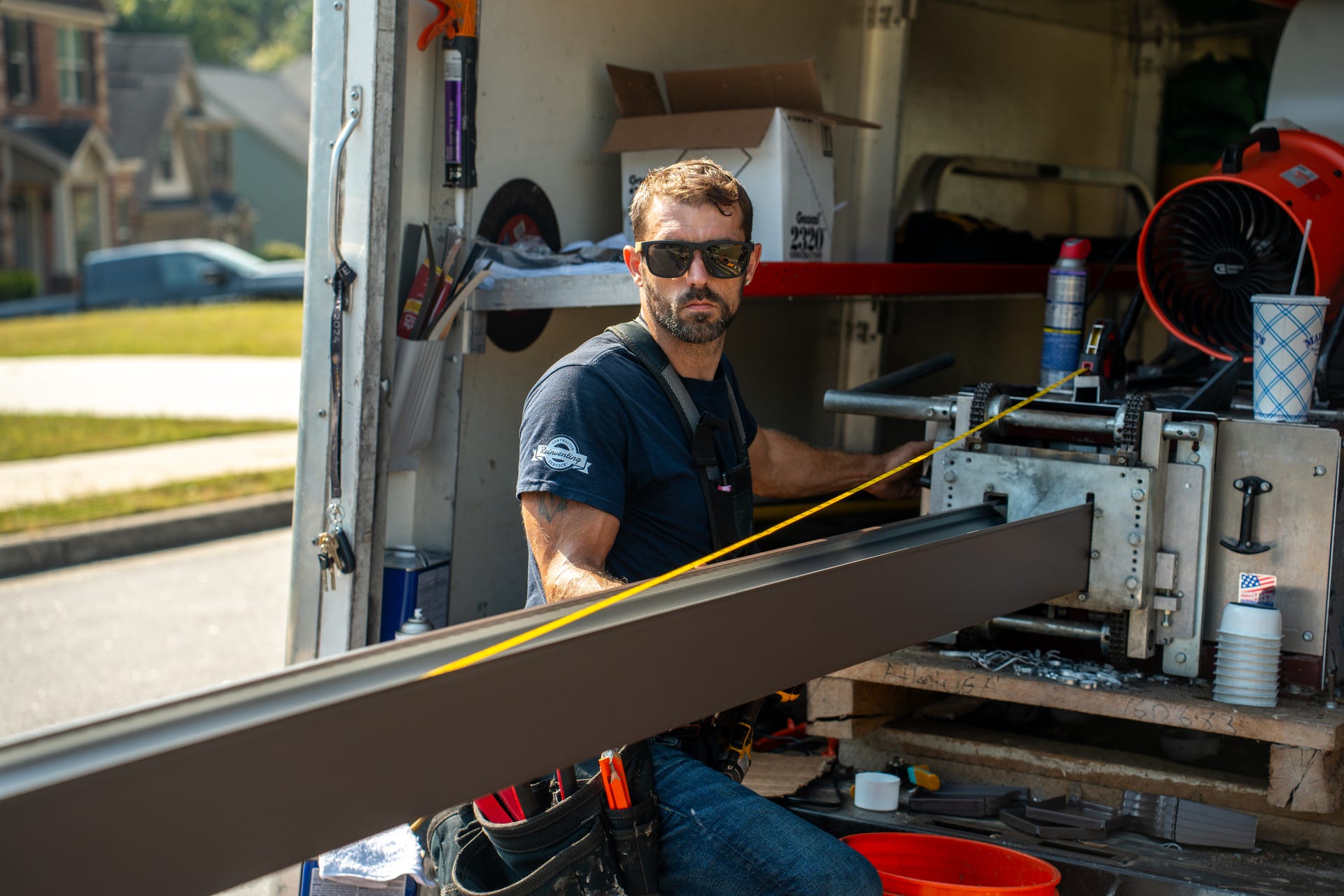
Our truck carries the gutter machine, so each run is formed on site to the exact length of that stretch of roof, with seams only at the corners and outlets.
- Walkthrough and written estimate.A Solutionist from Eric Dodge’s local Sunnyvale team measures every run, checks the pitch and the wood, traces where valleys and upper roofs land, and leaves a written, itemized price.
- Old system off.The crew takes down the old gutters and downspouts and hauls them away.
- Roof edge checked.With the gutters off, the wood is easy to see. Anything soft gets flagged so the new hangers go into solid wood.
- Formed at the curb.Each seamless gutter run comes out of the machine in one piece, in the size, profile and color on your estimate.
- Hung and sloped.Hidden hangers go in, and every run gets enough fall to empty completely toward its outlet.
- Water sent somewhere useful.Downspouts, plus downspout extensions and redirects where needed, carry water away from the foundation, walkways and crawl space vents.
- Water test and cleanup.We run water through the whole system, show you how it performs and leave the property clean.
When to schedule it
Summer, June through August, is the long dry window for new gutter runs and downspout upgrades. The goal is a finished system before the November to April storm season, because a replacement booked after the first big storm is a replacement done in the rain.
Guards, warranty and paying for it
A replacement is the easiest time to add BroGuard, our all-metal stainless micro-mesh guard, especially under oak, redwood or pine. Installed with new seamless gutters, the whole system is backed by our Limited Lifetime Warranty. Price depends on linear footage, roof access, the size and metal you choose, and the condition of the wood behind the old gutters. If you would rather spread the cost out, see our payment options, including financing through Wisetack.
Own a mid-century house with a very different roof? Our post on gutters for Eichler homes covers low-slope rooflines.
Wondering whether your older gutters have another winter in them? Call (650) 600-0598
Get a Free QuoteFrequently Asked Questions
Look at the pattern, not one leak. A drip at a corner or one sagging run on solid wood is a repair. Sectional joints leaking all along the house, steel rusting through, soft wood behind several runs, or the same spots patched every winter point to replacement. A Solutionist checks the whole system and prices both options in writing when both are real choices.
Properly maintained, well over 20 years. What gets a system there is keeping the trough clear of leaves and needles, fixing loose hangers early and keeping the pitch right, because standing water and extra weight are what wear gutters out. A fine mesh guard and a seasonal cleaning schedule help a new system reach its full life.
Only where the roof calls for it. A 6 inch gutter holds about 40 percent more water than a 5 inch and pairs with 3 by 4 inch downspouts, so it suits long runs, valleys, steep or tile roofs and lower gutters catching an upper roof. Many homes end up with 6 inch on a few runs and 5 inch everywhere else.
Near the fog and salt air in Pacifica, Daly City and western San Francisco, lean toward colored aluminum, copper or Galvalume and away from plain galvanized steel. Aluminum does not rust and costs the least, copper costs the most and lasts for decades, and Galvalume sits between them. Inland, every one of the four metals is a reasonable choice.
Yes, and replacement is the easiest time to do it. BroGuard, our stainless micro-mesh guard, goes on over the new seamless gutters and is fitted by the same crew that hangs them. Installed together, the whole system is backed by our Limited Lifetime Warranty. Under oak, redwood or pine it also cuts down how often the gutters need cleaning.
Free quotes
Ready to replace tired gutters on your older home, from Santa Clara to San Francisco?
Free, no-pressure written estimates from your local Sunnyvale crew. Each run sized for the roof above it, seamless gutters formed on-site and downspouts sent away from the house.
The Brothers That Just Do Gutters · Sunnyvale · (650) 600-0598 · Serving Sunnyvale, CA and the Peninsula, from Santa Clara to San Francisco